Monday, August 28, 2006

Lou Simpson

“You live by the sword, you die by the sword. If you are right, you are going to add value. If you are going to add value, you are going to have to look different than the market. That means either being concentrated, or, if you are not concentrated in a number of issues, you are concentrated in types of businesses or industries.”
Lou Simpson, GEICO Insurance

In The Warren Buffett CEO, Robert P. Miles introduces Lou Simpson as Berkshire Hathaway’s (NYSE: BRKB) back-up capital allocator. Simpson operates very much under the radar and is in charge of equity investments at GEICO, one of Berkshire’s insurance businesses. He has an impeccable record. Indeed, it is all but a forgone conclusion that in Buffett’s absence, Simpson will be responsible for capital allocation at Berkshire.

It took a while to get through this book. There is a lot of repetition with praise for each of the CEO’s of the various subsidiaries and their admiration for their boss. But in my opinion, the real message to take away from this book is that Berkshire is an assembly of many wonderful businesses run by dedicated manager owners who love their job and their businesses. Of course there are some subsidiaries which may be in for tough times such as the various shoe manufacturers. But GEICO, Gen Re, Flight Safety, Executive Jet Aviation (NetJets), Washington Post (NYSE: WPO) and See’s Candies along with a few furniture retailers are top notch businesses. The book also gives you a good feel for the kinds of people and businesses Buffett looks for as well as a culture which he has created to last even once he is no longer at the helm. That is the power of Berkshire.

The chapter on Lou Simpson alone makes this a worthwhile read. His business tenets are listed by Miles as follows:

  1. Read company reports and financial press voraciously. He reads 5 to 8 hours a day. His favorites are the Wall Street Journal, BusinessWeek, Fortune, Forbes and Barron’s. All must reads.
  2. Research any company extensively before making an investment.
  3. Don’t overpay.
  4. Think independently.
  5. Invest for the long-term.
  6. Hold only a few stocks. He thinks individual investors should hold no more than 10 to 20 stocks. We have talked about this before.

Remember our discussion about value vs. growth last October? It seems Mr. Simpson agrees with us: “When you ask if someone is a value or growth investor – they are really joined at the hip. A value investor can be a growth investor because you are buying something that has above-average growth prospects and you are buying it at a discount to the economic value of the business.”

Since we are talking about equity investments at Berkshire, here is a quick update. During Q2, its positions in Gap, Lexmark and Outback Steakhouse appear to have been completely eliminated. The company also disclosed that during Q1, it accumulated a $117 million position in Johnson & Johnson (NYSE: JNJ) – a wonderful company which was trading at a reasonable price.

Sunday, August 06, 2006

Short-Termism

"In the short run, the market is a voting machine but in the long run, it is a weighing machine".
Benjamin Graham, The intelligent Investor

A recent study by the CFA Centre for Financial Market Integrity and the Business Roundtable Institute for Corporate Ethics recommended companies stop giving quarterly guidance to encourage long-term thinking among managers, analysts to stop demanding short-term results and for asset managers to have their own wealth tied up in funds they manage.

It’s about time people start to pay attention. Indeed, a few companies are starting to back away from providing guidance. All this mumbo jumbo about missing analyst consensus by a penny or not meeting the whisper number is ludicrous. Meanwhile, ‘investors’ have punished shares of 3M (NYSE: MMM) and United Parcel Service (NYSE: UPS) in recent weeks even though the long-term prospects for those businesses are more than just average.

For long-tem investors, this behavior simply creates opportunity. The key is to be patient and have the discipline to believe in your investment thesis and not be swayed by short-term fluctuations in prices. Speaking of fluctuations, the market has provided a fun ride since March. After reaching its highest level in years in May, the S&P 500 fell by more than 7% at some point in June before recovering some of the lost ground and has been practically flat on a monthly basis from May to July. Our ‘value fund’ was also whipsawed during this period but recovered sharply in June thanks to a spectacular run in the shares of the NYSE Group (NYSE: NYX) which seem to have been battered for no apparent reason.

We are weighted heavily in these shares and still believe the shares are undervalued at these prices. Meanwhile, Atticus Capital LP, disclosed on Friday that it has almost doubled its holding in the NYSE Group and now owns just over 7% of the company with options to buy more shares. The firm also has stakes in Deutsche Boerse and Euronext, which has agreed to a $10 billion merger with NYSE. The deal is not done by any means as Deutsche Boerse remains a dark horse and could still derail the agreement. Stay tuned.

Charlie and Warren

I am a bit late with this one. But for you die hard value investors and Buffet fans, you have to check Charlie Rose’s three part series on Buffett. The Man, the Company and The Gift are well worth watching, especially the first two. You can find them on Google Video. I have ordered the DVD’s and will add them to the curriculum my son will surely have to complete before he makes his first ever investment. For now, as a 10 month old, he will have to trust his father. Tomorrow, he will be the proud owner of one share of Berkshire Hathaway (NYSE: BRKB) Class B share in his newly opened college savings account.

Sunday, July 16, 2006

α + β

No, we are not about to embark on a lesson in quantum mechanics. Alpha/Beta talk is the latest rage on Wall Street. Let's start with Beta which is basically supposed to symbolize risk - systematic risk to be exact. Beta is used to measure a stock's volatility relative to the overall market. So, for example, a stock with a Beta of 1 moves up and down with the market and therefore encompasses the same amount of systematic risk. Of course, modern financial theory, albeit incorrectly, equates volatility with risk. So the higher the Beta for a stock the riskier it is supposed to be. There isn't much you can do about this kind of risk. The simplest way out is to buy an index fund and do away with the risk altogether.

There is also a non-systematic component to risk which is specific to the business you are investing in. Outperforming the market will depend on how well you mitigate this kind of risk. You certainly can't diversify it away by holding 150 stocks in your portfolio as many mutual fund mangers on Wall Street tend to do. As we have discussed before, the way to go is to build a concentrated portfolio which contains businesses you really understand and bought after a lot of thought and due diligence.

Apparently, there is another way to accomplish this and it involves Alpha. Wall Street firms' ability to conjure up portfolio "strategies" which puts more fees in their pockets is once again on display here. A recent Wall Street Journal article explained how "Portable Alpha" works. The most recent issue of Institutional Investor also had an insert which devoted a section to "Alpha Beta Separation" strategies. What is all the hoopla about? Here is how it's supposed to work. Clients are advised to get exposure to their benchmark index (Beta) through the use of derivatives, freeing up cash to allocate to Portable Alpha - money managers using hedge fund type strategies to boost returns above and beyond the Beta portion of the equation. You got it. The whole pie in the sky pitch assumes that these money managers will consistently beat the market. Well, that just doesn't happen (see Dreman's book for more details). Oh, and I forgot to mention that proponents of Portable Alpha charge hedge fund type fees to boot. It doesn't get any better than that. The Journal noted that "critics say portable alpha is nothing but Wall Street hocus-pocus that lets money managers rack up higher fees." They took the words right out of mouth.

Wednesday, July 12, 2006

The Weather Channel

A recent Wall Street Journal article highlighted the fact that demand for catastrophic reinsurance products is outstripping supply. Meanwhile, hedge funds and private-equity firms are filling the gap by providing coverage in certain cases. But don’t forget the king of reinsurance, Warren Buffett. Indeed, Berkshire Hathaway is making a big bet on mega-cat reinsurance even as others flee. And here is yet another classic quote from Mr. Buffett on the subject: "If you like to watch football, you probably enjoy the game a little more if you have a bet on it. I like to watch the Weather Channel." Gotta love it!

Saturday, July 08, 2006

Blue Gold

Over the past couple of years, sporadic articles have appeared in BusinessWeek and the Wall Street Journal about water. The sector certainly seems to be under the radar and yet water related indices such as the Bloomberg World Water Index of 11 utilities has returned 35% annually since 2003, far outpacing the S&P 500 and even various oil and gas indices.

A little bit of digging unearths a plethora of information about gloomy forecasts of a water shortage over the next couple of decades as well as neglected water infrastructure in various countries. From the United Nations to the OECD to the Environmental Protection Agency, there is no shortage of opinion on global water issues.

Big money is certainly getting onboard and has been gearing up to take advantage of the opportunities. The Gabelli Fund recently organized its first Water Infrastructure Conference and is one of the largest shareholders of Watts Water Technologies (NYSE: WTS). Then there is General Electric (NYSE: GE) which has water purification and treatment businesses and expects the opportunity to grow significantly going forward.

We have had the water sector on our radar for some time. Various stocks have pulled back from recent highs and appear to be trading at reasonable valuations. ITT Industries (NYSE: ITT) and Pentair (NYSE: PNR) are a couple of examples. There is also the PowerShares Water Resources ETF (AMEX: PHO) if you don’t want to pick and choose.

We finally pulled the trigger on a mini-conglomerate which recently decided to spin off it water infrastructure business through an IPO. Walter Industries (NYSE: WLT) which has also been the target of various activist hedge funds has been on a wild ride recently.

We first took a position at around $65 and then again at $44 during the recent market decline. The remaining shares of Mueller Water Products (NYSE: MWA) should be distributed to Walter shareholders in short order. Walter currently owns about 75% of the Mueller. A bunch of Wall Street firms initiated coverage of Mueller couple of days ago. Let’s take $20 as a price target. At that price, Walter’s stake in Mueller accounts for $38 of its stock price which is trading at about $55. In other words, you are getting Walter’s natural resources (coal and gas), homebuilding and financing businesses for about $17 a share. Let’s say the homebuilding and financing businesses are worth about a couple of dollars. This leaves $15 for the natural resource business. Assuming a coal segment comparable P/E of 14, this part of the business would only have to earn $0.93 to justify this price. This is way too conservative even if coal and gas prices decline significantly. Plus, the company has locked in the price for its coal through next year at above $100 per metric ton. And I expect demand for Walter’s high quality metallurgical coal used by the steel industry to be sustained for some time.

I think Walter Industries is worth at least $75. So get in on the Blue Gold rush by buying Walter shares and waiting for the full spin-off of Mueller.

Saturday, June 10, 2006

The Sell-Off

“Face up to two unpleasant facts: the future is never clear and you pay a very high price in the stock market for a cheery consensus. Uncertainty is the friend of the buyer of long-term values.”
Warren Buffet, Forbes, August 1979

It has been a fun ride over the past 4 or 5 weeks. The Dow, Nasdaq and S&P 500 have corrected by about 7%, 10% and 6% respectively. Ouch. The volatility stems from the market’s uncertainty over the Fed’s interest rate policy and whether or not Mr. Bernanke will follow through with the Fed’s 17th consecutive rate hike in late June. Inflation appears to have pierced Mr. Bernanke’s 1%-2% comfort zone, albeit fractionally, and that has made investors jittery. Add to that the carnage in emerging markets in recent weeks and you have yourself a real doozy of a situation.

What to do? Does it make sense to sell, sell, sell a la Jim Cramer or should you instead be taking advantage of the sell-off to add to your positions. By now you should know what my answer will be. To be fair, my brother and I have trimmed or eliminated some positions in recent weeks. In particular we liquidated our Goldcorp (TSX: G.TO) position, took some money off the table on Chaparral (Nasdaq: CHAP), and reduced our position in Vimpelcom (NYSE: VIP) by 50%. Otherwise, we have used the decline to add to some of our core holdings. We have added to Ebay (Nasdaq: EBAY), Intel (Nasdaq: INTC) and Microsoft (Nasdaq: MSFT). We also nibbled a bit more at Centex (NYSE: CTX) and may do the same with Pulte (NYSE: PHM).

The homebuilders have been beaten up badly as they continue to reduce their earnings forecasts and worries about further interest rate hikes weighs on their shares. But my thesis remains intact. Scarcity of land and demographics are still positive long-term trends that should benefit the larger players. Further pain in the sector will also provide them with the opportunity to drive consolidation through the sector by gobbling up weaker players. Meanwhile, Bill Miller continued to build his positions in these companies through Q1. When we initiated our position in the homebuilders, I told my brother there could be a 20% downside in the shares. That scenario sure has materialized. To add fuel to the fire, a slightly worrisome article in a recent issue of Barron’s questioned the nature of off-balance sheet JV’s set up by various homebuilders to boost ROA and ROIC. The article also questioned whether the companies can truly walk away from the options they have purchased to buy land. Various CEO’s have claimed the use of these options will reduce their financial exposure during a downturn. In any event, I continue to believe in the soft landing scenario for housing. These companies have been around for decades and they are certain to provide us with a reasonable rate of return in the long run.

2p - 1 = x

“We try to think like Fermat and Pascal would if they’d never head of modern financial theory.”
Charlie Munger

In his book The Warren Buffett Portfolio, Robert Hagstrom does an excellent job outlining his thoughts on the focus investment strategy and the psychology of investing. But two chapters in his book in particular caught my attention.

The sixth chapter is titled The Mathematics of Investing. Hagstrom discusses probability theory and the important role it plays in Buffett’s and Munger's decision process. In one example, Buffett takes us through his thinking when he purchased a significant stake in Well Fargo in 1990 just as the West Coast was in the midst of a recession and banks with exposure to residential and commercial mortgages were thought most vulnerable. Wells Fargo’s stock had declined from $86 to $57. An approximately 50% decline.

But this was a bank that was earning $1B pretax at the time. Even if its entire loan portfolio – not just the real estate loans – were hit severely, the bank would still break even. Buffett reasoned that " a year like that ... would not distress us". Other risks existed but Buffett assigned a low probability to those as well. In the end, Buffett figured the odds of making money on the shares were on the order of 2:1 providing him with his Margin of Safety. The shares continued their decline after he bought them and were up only 5% the next year. But in 1992 and 1993 the shares appreciated 34% and 73% respectively, followed by more gains in subsequent years. Not bad.

Another interesting tool introduced by Hagstrom is the Kelly Optimization Model, 2p – 1 = x. It suggests that if you know the probability of success (p), you bet the percentage of your capital (x) that will maximize return. So if you think the probably of buying Coca Cola (NYSE: KO) has only a 55% chance of giving you above average returns over the next decade, you should invest 10% of your portfolio in the stock. It is not clear if Buffett uses this formula in his thinking, but he certainly makes a big bet when he likes his chances. Consider that in 1988 – when he began building a position in Coca Cola – Capital Cities/ABC, GEICO, Coca Cola and the Washington Post comprised 36%, 28%, 21% and 12% of his portfolio respectively.

The eight chapter introduces the concept of the market as a complex adaptive systems. The market has many agents (people) who have their own partial views and biases. They interact with other agents, none of them in control of the market, accumulate experiences and adapt to the constantly changing environment. Such a system is impossible to predict and forecast, especially in the short-term. Buffett says, “We have long felt that the only value of stock forecasters is to make fortune tellers look good.” In other words, don’t worry about price fluctuations, just focus on the economics of the business you are investing in and be assured that in the long-run, the market will reward companies that create shareholder wealth. Of course, all of this assumes you have done your homework and you are buying stock at a reasonable Margin of Safety.

Absolute Focus

“Imagine the cost to us, if we had let a fear of unknowns cause us to defer or alter the deployment of capital.”
Warren Buffett, Berkshire Hathaway Annual Report 1994

Being a successful investor is all about patience, discipline, focus and conviction. How you measure your success is also very important. Most money managers and mutual funds have locked themselves into a relative measurement game. They better deliver returns relative to their chosen benchmark or else! The benchmark can be the S&P 500 index or the Russell 2000 index. This is exactly why these funds end up owning a large number of equities in their portfolios, sometimes in the 100s. You have to own the market to keep up with the market. This is also one reason why 90% of them end up underperforming the market. So if you want average returns, this is the path you should follow.

If you want above average returns, you must become a focus investor measured on absolute performance. Forget about the day to day and short term gyrations of the market and concentrate on the economic value of the businesses you invest in. As we have discussed in the past, holding a large number of stocks in your portfolio doesn’t reduce the risk, it just spreads the risk. You are better off building a focused portfolio which enables you to become intimately familiar with each business you own. Don’t forget, you are part owner of a business when you buy stock, even if it’s just a 100 shares.

How many holdings should a focused portfolio have? Well, Warren Buffett has said he would not consider making an investment unless he is convinced he would want to commit at least 10% of his net worth. This implies a portfolio of 10 holdings. His partner, Charlie Munger, who had started his own partnership in the 1960’s had concluded that owning as few as 3 stocks would provide him with above average returns. And he was right. From 1962 to 1975, his partnership returned an average of 24.3% annually vs. the market's 6.4% return. The one caveat was that he achieved this by enduring increased volatility. The portfolio significantly underperformed the market in some years.

Indeed, a focused portfolio is not for the faint of heart. You must have the temperament and psychological wherewithal to stand the peaks and valleys. You must be patient, avoid the temptation to buy and sell and ignore market forecasts. After all, wars and market crashes and oil shocks did nothing to deter Warren Buffett from staying the course. You may underperform the market from time to time, but in the long run you should handily meet or exceed an absolute measure of performance such as inflation plus 10%.

Wednesday, May 31, 2006

Tracking Buffett 2

It's that time again. It's been more than six months since we reviwed Buffett's stock holdings. A lot has been going as Mr. Buffett has been busy putting his cash to work. He has reduced or eliminatd some positions while taking significant new positions along the way.

Berkshire significantly reduced its stake in Pier 1 (NYSE: PIR) as the furniture retailer has continued to struggle. He continues to hold a small position. Apart from a few full divestments, Buffett has pared back his positions in H&R Block (NYSE: HRB) by around 40%, Gap (NYSE: GPS) by 35%, Sealed Air (NYSE: SEE) by almost 38%, and Iron Mountain (NYSE: IRM) by 30%. I was a bit surprised by the 16% reduction in Home Depot (NYSE: HD), but this does not seem to be a significant sale at this stage since he had increased his position by 429% in Q3 of 2005. In fact I would use a bit more weakness in the shares to add to my position.

Meanwhile, the additions to the portfolio are worth paying attention to. Lots of attention. I have already talked about Anheuser-Busch and Wal-Mart in a previous post and continue to hold both stocks. Buffett increased his Wells Fargo (NYSE: WFC) holding by 50% and Lexmark (NYSE: LXK) by 200%. Lexmark had plunged more than 30% in Q4, when Buffett added to his position, and has almost fully recovered. Also since last September, Berkshire has doubled its Tyco (NYSE: TYC) stake. We have also used recent weakness in the shares to add to our position.

During the latest quarter, Berkshire took new positions in General Electric (NYSE: GE), United Parcel Service (NYSE: UPS), and ConocoPhillips (NYSE: COP). Foreign stock additions to the portfolio include Diageo PLC and Tesco PLC. What all these companies have in common is international revenue exposure. As I noted in a recent post, Mr. Buffett is using this strategy to hedge against further deterioration in the US Dollar. He is probably just getting started. I have been a GE shareholder for almost a decade and would use any weakness in the shares to add to my position in the low $30s. As for ConocoPhillips, it trades at a discount to peers primarily because of the company's aggressive exploration expenditures. Regardless, the new position is an endorsement by Mr. Buffett that high energy prices are here to stay. In energy, I have been a shareholder of Canadian income trusts with exposure to the Oil Sands as well as Encana (NYSE: ECA) and Petro Canada (NYSE: PCZ).

Stay tuned as Mr. Buffett continues to deploy his cash.

Thursday, May 25, 2006

Capitalists’ Woodstock

On May 6th 24,000 people made their pilgrimage to Omaha, Nebraska to take part in the festivities planned around Berkshire Hathaway’s (NYSE: BRKB) annual meeting. Warren Buffett and his partner in crime, Charlie Munger, did not disappoint their disciples. By all accounts, the weekend was as informative and entertaining as would be expected. The highlight for me was the exchange between Buffett and Munger about hedge funds and private equity funds.

“We have so many deal flippers in the game they're going to get in each other's way. How will private equity firms continue to make money by just flipping and flipping and flipping and flipping?” asked Munger.

“They'll make it on fees, fees, fees," quipped Buffett, adding that when he gets a call from a private equity group, he puts the phone down "even faster than Charlie".

Also of note was Berkshire’s announcement of a $4 billion transaction to acquire 80% of Israeli machine tools company, Iscar Metalworking. What is significant about this is that the deal signifies the first major ex-US acquisition for Berkshire. It most definitely will not be the last. Buffett reduced his bet against the US dollar significantly in Q1, but by buying foreign assets he is in essence accomplishing the same thing. More deals will surely follow. He also alluded to a $15 billion transaction in the works but gave it a low probability of closing.

Slowly but surely Buffett is putting his cash to use. While he continues to take significant minority stakes in companies such as Wal-Mart (NYSE: WMT) and Anheuser Busch (NYSE: BUD), his preference is clearly to buy operating companies that fit his investment criteria. Since last year’s acquisition of PacifiCorp, he has put more than $10 billion to work. He also implied that in three years Berkshire will have significantly less cash than today. Indeed, he has suggested Berkshire would like spend more than $15 billion in the energy sector alone. His target seems to be a cash position of $10 billion compared to nearly $40 billion today.

Skeptics continue to question Berkshire’s prospects. They contend Buffett has lost his touch as evident by the cash hoard he carries on the Balance Sheet. Incidentally, Berkshire’s businesses generate $100 to $200 million of cash a week. Not bad. In any case, these skeptics are missing the point. This is value investing at its best. No rush. Patience and discipline are the governing rules. Nobody does it better than Buffett. The whole idea is to be invested in Berkshire before he has deployed the cash. Meanwhile you are safekeeping your cash with the greatest investor of all time. Not to mention the fact that Berkshire is one of a handful of AAA rated companies around (it's also the only AAA rated reinsurer) and a rock solid investment, period. More importantly, the shares remain at least 25% undervalued as book value and earnings power continue to rise. The recent dip in the shares represented a great opportunity to add to holdings.

Friday, April 21, 2006

Home Sweet Home

People will always need a place to call home. Indeed, housing has been a hot topic of discussion lately. The consensus goes something like this: The Fed is raising rates which will render mortgages expensive for consumers. Cracks are beginning to show in the foundation as orders for new homes are on the decline and new home sales are hitting their lowest levels in recent years. Of course, this is supposed to spell doom for homebuilders such as Pulte Homes (NYSE: PHM) and Centex (NYSE: CTX).

Wall Street's reaction has been swift and punishing. Homebuilders stocks have retreated from their highs and are trading at extremely low P/E ratios by historical standards. In fact, the hombuilders have the lowest P/E of any major industry sector on the stock market (Dreman anyone?!). On a forward P/E basis, the leading companies are trading at a 2 to 3 times discount to the S&P 500. But people forget that these companies have been around for decades and have been through many cycles. That experience has served them well as they have transformed their businesses into conservatively capitalized enterprises, managing cash while focusing on shareholder returns. Just look at the return on equity they are delivering. They don't own excess land and are dominant enough to drive a wave of consolidation through the sector should things go awry and the smaller rivals begin to falter.

Don't forget that the Fed should be close to ending its string of rate hikes. That should lessen the severity of the gloom and doom scenario predicted by naysayers who believe higher rates will destroy the consumers' appetite for homes. Meanwhile, the economy seems resilient and wages are on the rise giving the consumer enhanced buying power. Sure, the housing market in some markets is frothy to say the least and homebuilders themselves admit as much. But a softening market or a gradual leveling out is the more likely scenario than a severe crash.

It is practically impossible to call a bottom on a stock. Pulte and Centex are the two largest homebuilders by revenue and are both repurchasing shares. Their book value (which is a conservative estimate of the liquidation value for these companies) puts a nice support under the shares. I think the downside is manageable while there could be a 25% to 35% upside in the shares.

The Contrarian

"Nobody beats the market, they say. Except for those of us who do."
David Dreman January 21, 1998

You would not be a value investor without having a contrarian edge and a thorough understanding of investor psychology. The contrarian of them all is David Dreman. He has been a Forbes columnist for many years and is considered the father of contrarian investing.

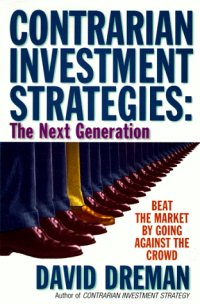
In Contrarian Investment Strategies: The Next Generation, Dreman reminds us that the opinion of a Wall Street analyst is not gospel. He will also remind you that markets are far from efficient and that investors overreact in predictable irrational ways which you can profit from. He presents compelling data and statistics which show low P/E, low P/Book and low P/Dividend stocks have outperformed the market over time. He recommends sticking with high quality companies and staying away from bonds which have seriously underperformed stocks when adjusted for inflation and tax.

His 41 Contrarian Investment Rules are valuable reminders of how hard it can be to avoid the herd mentality. Here are a few:

Rule 1 - Do not use market-timing or technical analysis. These techniques can only cost you money.

Rule 2 - Respect the difficulty of working with a mass of information. Few of us can use it successfully. In-depth information does not translate into in-depth profits. (AA note: for more on the powers of rapid cognition without the need for exhaustive deliberation, you should read Malcom Gladwell's Blink)

Rule 6 - Analysts' forecasts are usually optimistic. Make the appropriate downward adjustment to your earnings estimates.

Rule 10 - Take advantage of the high rate of analyst forecast error by simply investing in out-of-favor stocks.

Rule 11 - Positive and negative surprises affect "best" and "worst" stocks in diametrically opposite manner.

Rule 14 - Buy solid companies currently out of market favor, as measured by their low P/E, P/Cash Flow or P/Book ratios, or by their high yields.

Rule 20 - Buy the least expensive stocks within an industry, as determined by the four contrarian strategies, regardless of how high or low the general price of the industry group.

Rule 25 - Don't be seduced by recent rates of return for individual stocks or the market when they deviate sharply from the past. Long term returns of stocks are far more likely to be established again.

Rule 29 - Political and financial crises lead investors to sell stocks. This is precisely the wrong reaction. Buy during a panic, don't sell.

Rule 30 - In a crisis, carefully analyze the reason put forward to support lower stock prices - more often than not they will disintegrate under scrutiny.

Rule 32 - Volatility is not risk. Avoid investment advice based on volatility.

Rule 41 - A given in markets is that perceptions change rapidly.

Mentally, these rules can be hard to adhere to especially when the value stocks you own do not participate in hot-stocks-du-jour rallies. A disciplined and patient value investor with a contrarian psyche is a rare breed. But I believe such an investor has the best shot at mastering the stock market. It's a good thing markets are not efficient after all.

Thursday, April 06, 2006

Intel

A few days ago a friend asked me about my opinion about Intel (Nasdaq: INTC). I have been an Intel shareholder for many years and I have continued to add to my position even as the shares have continued their rather dramatic decline recently. At current levels, Intel is not your pure value play, but it's getting there. I believe the shares provide a reasonable Margin of Safety and would expect any further declines to be relatively moderate from these levels. The company is buying its shares back aggressively and I expect will continue to increase dividends. Here is an excerpt of the email I sent back in reply earlier today.

“Intel is definitely a disliked stock right now, which is why it’s on my radar screen. The company has had some missteps lately. AMD (NYSE: AMD) is hot on its tails and has been taking share especially in server market. And there are rumors DELL (Nasdaq: DELL) might soon start using AMD chips and stop being exclusive to Intel. All these are negative overhangs on the stock. Plus you have the likes of Texas Instruments (NYSE: TXN) and Marvel (Nasdaq: MRVL)) which seem to have products which are better targeted at today’s most popular consumer electronic gadgets. But Intel is not sitting still either. They continue to spend on R&D and have managed to stay ahead of AMD in cranking out chips more efficiently, leveraging the company’s economies of scale. AMD has made up some ground though. Intel is also diversifying into other areas as evident by their recent partnership with Micron. Not to mention the fact that Microsoft’s Vista will be rolling out next year (hopefully!) and it should bring with it a whole new round of upgrades. Finally, there are the emerging markets, where Intel and AMD are trying to gain a foothold, and which will eventually present the companies with growth opportunities. Worst case scenario, by the way, is that Intel will use a price war to crush AMD. A strategy it has used in the past.

Intel remains the powerhouse of the industry. The company has solid Return on Equity and profit margins (although some think the margins have peaked for the company). The stock pays a 2% dividend at these levels. Not bad and I think they will continue to raise the dividend. On a forward P/E basis, the stock is trading at around 18.5 times 2006 projections and about 15.2 2007 projections. That is compared to the S&P 500 which is trading at 16.1 times 2006 estimates and 15.5 times 2007 estimates. So the question is, does Intel deserve a premium multiple to the market. My position is that the answer is yes. So you could buy the stock just on this basis if you are a long-term investor.

Here is another way to look at things.

Is the stock a value play? In my opinion, it’s not a true value play but if you believe Intel can continue to grow and earn above its cost of capital for every additional dollar of investment, then there might be a reasonable margin of safety provided by that growth assumption. Based on my calculations, Intel is currently trading at about 1.8 times adjusted book value. Not the cheapest it has been historically. Also, I have calculated the company’s Earnings Power Value to be about $80 billion dollars. EPV assumes no growth. Intel would be a beautiful value play if the market cap was closer to this number, because then you would be getting the growth for free. That was the case for Intel in the early ‘90s, for example.

So on this basis, we would not buy Intel today as a pure value play. But we should consider the possibility that growth may provide us with a Margin of Safety above and beyond the EPV we have calculated. I have made the following assumptions (which you could challenge of course), but I think they are reasonable:

Return on Equity: 23%
WACC: 12%
Growth rate: 8%

With those assumptions, I get a Present Value/EPV ratio of about 2. This means Intel’s PV = 2 * EPV = $160 billion or about $26.3 providing us with a margin of safety of 36% over the current price of $19.3.

The closer the market cap gets to my EPV figure, the more comfortable I will be. But for the market cap to be equal to EPV, the stock would have to drop to $14. Possible? Sure. I think it is unlikely, unless the entire market crashes of course (but that is just systematic risk we can’t do anything about). Could the stock hit $17 or $18 in the near term? Sure. But that is why I think you can take a half position now and the rest after the earnings announcement.

One more thing to think about. This company is a cash machine with a squeaky clean balance sheet. They can take on more debt if they want to and they might end up paying a special dividend a la Microsoft (Nasdaq: MSFT) if they can’t figure out what to do with that cash. The stock traded at these levels back in 1996!”

Saturday, March 25, 2006

Timmy's IPO

Friday was the big day. Tim Horton’s (NYSE: THI) IPO was priced at USD $23 and opened at nearly $30. This values the company at almost $6 billion! Meanwhile, Wendy’s shares (NYSE: WEN), retreated to $63 and held steady after briefly hitting an all-time high of $66.35. Based on my last post, this would have resulted in roughly a 13% return on investment in little over a month, not including dividends. Not bad.

What now? The main thesis of my rational behind buying WEN in the first place remains intact. On Friday, THI closed at $28. Remember WEN still owns 85% of Timmy’s. So at that price, the 85% stake represents approximately $38.5 of WEN’s share value. The remainder, or $24.5, is the value the market is attributing to the Wendy’s franchise. That translates to an enterprise value of roughly $3 billion which is still only 8.5 times EBITDA. This is an improvement since Peltz filed his 13D but the multiple is still below the 9 to 11 times for Wendy’s peer group.

There is more work to be done. The Baja Fresh brand still needs to be divested. Some underperforming restaurants will be sold once store-level margins have been improved. Meanwhile management has committed to continue to cut costs to improve EBITDA. Finally, cash from sales of any ancillary businesses and the $5 per share proceeds from the THI IPO will have to be put to work. Once Timmy’s has been 100% spun off (before the end of the year), management will put this cash to use to buy back shares or pay a special dividend or a combination of both.

There are risks. There is no guarantee THI will hold at these levels. Furthermore, there is no guarantee Wendy’s management team will be able to hit Peltz’s targets. But if you are a believer, you will collect around 1.4 shares of THI for every WEN shares you are holding and based on my calculations, you will benefit from another 20% to 25% appreciation as the Wendy’s franchise mounts a comeback.

I continue to like WEN as a value play. Even if the THI IPO frenzy fizzles away, the downside seems minimal. In fact, if the THI does retreat to the IPO price or below, I will snap up shares in a heartbeat. Meanwhile, holding WEN gives you the opportunity to participate in any further, albeit unlikely, gains in THI in the short-term.

Let’s let the story unfold.

Friday, March 17, 2006

AA Value Fund

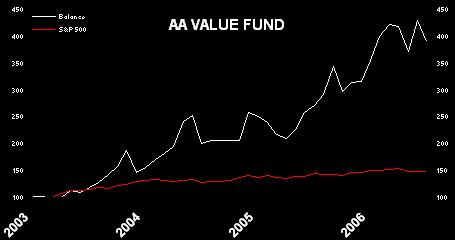
I opened my first brokerage account at Charles Schwab while I was attending MIT in 1995. I will never forget walking into a Schwab branch and seeing two young kids, supposedly there to greet potential customers, glued to their monitors trading options on tech stocks. It was the beginning of a euphoric period that did not end well. I have to confess that I was caught in the ‘irrational exuberance’ of the moment also. An investment club I co-founded in 1996 had a return of 6 times invested capital before giving up all the gains and more once the technology bubble burst. Needless to say times have changed. So have my investment discipline and philosophy.

From time to time I will update you on my performance as I continue to hone my skills as a value investor. Since the beginning of 2003 and through the end of 2005, my ‘value fund’ has returned a CAGR (Compound Annual Growth Rate) of approximately 46% vs. S&P 500's 13%. This performance does not include any additional capital contributions to the account. I prefer not to turn Margin of Safety into a stock picking showcase, so I am not going to get into the rationale behind each holding and how the individual investments performed. As you may have noticed, I prefer to talk about general themes with a few sprinklings of ideas you may find interesting. If you are interested in learning more about my individual picks, you can visit Ivey's Super Investors.

To give you an idea of typical past and current holdings in my value fund since inception, here is a list in no particular order: American Real Estate Partners (NYSE: ACP), Sears Holdings (Nasdaq: SHLD), Petrobras (NYSE: PBR), Smith International (NYSE: SII), Morningstar (Nasdaq: MORN), NYSE Group (NYSE: NYX), Pier 1 (NYSE: PIR), Intel (Nasdaq: INTC), Cisco (Nasdaq: CSCO) and Amazon (Nasdaq: AMZN). Here is what the journey has been like so far.

Sunday, February 12, 2006

Intrinsic Value

“Many shall be restored that are now fallen and many shall fall that are now in honor.”
Horace, the Latin lyric poet and satirist, Ars Poetica

That is a quote Benjamin Graham used in the first edition of Security Analysis in 1934. Any value investor should know it by heart. It is very difficult to make investment decisions which defy herd mentality on Wall Street especially when those decisions mean ignoring the hot stocks de jour.

The discipline of value investing is a powerful and time-tested approach which has rewarded its disciples through bear markets, bull markets and recessions. Bruce Greenwald’s Value Investing – From Graham to Buffett and Beyond does a superb job laying out the fundamentals as they have evolved since Graham pioneered this school of thought. The book uses case studies to reinforce the concepts including a detailed look at Intel in the late ‘80s and early ‘90s. The second half of the book consists of 8 chapters devoted to the investment approach of some of the most celebrated value investors of all time including Buffett, Greenberg, Klarman and the Schlosses.

This book will become an invaluable investment resource and you will end up referring back to it over and over again. Here is a quick primer on how you estimate the intrinsic value of a security:

  1. Calculate the Net Asset Value of the company. You do this by calculating the Reproduction Cost of the assets. In other words, if a competitor were to enter the market, how much would it need to spend to get in the game. The NAV is calculated by making adjustments to the Book Value which include R&D and Marketing and Advertising expenditures a competitor would need to spend in order to become a genuine challenger. You can use the adjusted book value to calculate a Market Value to NAV ratio as an initial gauge of how expensive a stock may be.
  1. Calculate the Earnings Power Value of the company. To calculate EPV, you start with operating income (EBIT) and make adjustments which include adding back depreciation and amortization and subtracting capital expenditures. This is the same as the distributable cash flow to shareholders assuming no growth. A hard core value investor never assumes any growth when calculating the intrinsic value of a company. We will get to this later. This number is then divided by the cost of capital to calculate EPV. Note that a value investor does not have to contend with the practically impossible task of estimating what a company’s growth prospects may be five or ten years down the road. This eliminates a lot of uncertainly. Incidentally, the difference between the EPV and the NAV, when positive, is called the franchise value. In other words, the company’s moat. The EPV must then be adjusted so you can compare it with the current market cap of the company. To do this, you subtract interest bearing debt and add back all cash in excess of 1% of sales (1% of sales in cash is about how much is needed to operate a company). For a value investor, this is the intrinsic value of the company. Ideally you want to buy the stock when it is trading below the EPV to provide yourself with a Margin of Safety.
  1. So what about growth? What value can we ascribe to growth when we are calculating the intrinsic value of a company such as Intel? The answer is simple. You have to assess whether the company can grow without destroying shareholder value. I won’t get into the details, but basically if the company is going to reinvest excess cash into its operations, it must earn in excess of the cost of capital to create value for existing shareholders. Greenwald calls this growth within the franchise. To calculate what I will call the Growth Factor which is the ratio of the Present Value of Future Cash Flows (PV) to EPV, you need to estimate a growth rate and calculate two ratios: Return on Equity/Cost of Capital and Growth Rate/Cost of Capital. Don’t worry about the math, but with those two ratios in hand you can calculate a Growth Factor. This is how it works. A ratio of 2.0 means the company’s intrinsic value could be twice the calculated EPV. Conversely, if you decide to buy the stock at EPV, the company’s growth should provide you with a 50% Margin of Safety.

A lot has changed since Greenberg wrote the 2001 edition of his book. But keeping his assumptions constant for a quick back of the envelope calculation justifies a $27 intrinsic value for Intel (Nasdaq: INTC). At today’s price this provides only a 25% Margin of Safety. Not enough for a value investor.

Monday, February 06, 2006

Timmy and Wendy

Canadians love their Tim Horton’s coffee. Canada’s version of Starbucks Coffee (NASDAQ: SBUX), affectionately referred to as Timmy’s, has been an enormous success since its first store opened in 1964. In 1995, Wendy’s International Inc (NYSE: WEN). merged with Tim Horton’s and facilitated its entry into the US market. Over the past 5 years, Timmy’s has carried Wendy’s on its back and has masked the dismal results at the Wendy’s franchise.

Last July, a hedge fund run by Bill Ackman, Pershing Square Capital, demanded that Wendy’s management raise dividends, initiate a more substantial share repurchase program and implement a partial spin-off of Timmy’s. The shares jumped on the news from around $45 to just above $50 and then retrenched before resuming their upward trend. Ackman has been successful in his recent bid to shake things up at MacDonald’s.

In December of 2005, another well-known hedge fund manager, Nelson Peltz, entered into the picture and made more demands. Most significantly, Peltz asked management to implement a complete spin-off of Timmy’s, sell ancillary businesses improve Wendy’s abysmal operating margins by bringing then on par with industry peers. Previously, he successfully turned around Arby’s and Snapple.

In their regulatory filings, Peltz and his Trian partnership disclosed a 5.5% stake in Wendy’s shares at prices ranging from $48 to $51. After that filing, Wendy’s shares jumped to $55. Trian’s filings lay out the recipe for unlocking value for Wendy’s shareholders. The 13D filing is available on SEC’s web site and makes for educational reading. Trian pegs Timmy’s worth at $32 to $36 a share. These numbers were floating around in a few articles on the internet earlier in the year. Trian’s main thesis is that operating margin at Wendy’s franchise can be almost doubled implying a share value of at least $45 for a total valuation of $77 or higher.

I did not catch wind of all this until middle of January. At $45, Wendy’s shares were a huge bargain. If you believed the rumors that Timmy’s would float at $36, Wendy’s franchise was available at $9 a share! While Wendy’s restaurants’ results have not been spectacular, there is no reason to believe that a competent management team could not turn things around. In any case, perhaps hindsight is 20/20. The question we should ask now is if the shares are worth a look at current prices, hovering around $57?

Rumors are that Timmy’s shares will be in high demand. The IPO share price may be as high as $38. The recent success of MacDonald’s (NYSE: MCD) Chipotle Mexcan Grill (NYSE: CMG) spin-off highlights the market’s appetite for this sector right now. Plus, without getting into much detail (I will let you read Timmy’s S1 on your own spare time), Tim Horton’s is a solid growth story. If the shares float at $38, Wendy’s implied valuation per share is about $19. This means there is plenty of value left in the shares if you believe Trian’s pitch and management’s ability to institute a turnaround. Moreover, by buying Wendy’s shares today, you will “lock in” any potential appreciation in Timmy’s shares after the IPO.

Peltz may not get all his wishes. Today, Wendy’s management announced that Timmy’s shares will be fully distributed in 9 to 18 months after the IPO citing tax efficiency reasons. Peltz had hoped for a speedier distribution. On the other hand, Wendy’s management laid out numerous other initiatives to improve efficiencies, sales and margins. While they did not acknowledge Peltz, it seems to me they are on the right track and have effectively endorsed Peltz’s recipe for a turnaround. It will be interesting to see how Peltz reacts to these initiatives.

In my opinion, Wendy’s shares offer a compelling valuation at these levels. While some of the margin of safety may have been eroded over the past 6 months, I believe the prospect of a well received Tim Horton’s IPO warrants taking a position in Wendy’s shares today. Wendy’s franchise will not be fixed overnight, but there is no reason why the operational efficiencies cannot be brought inline with industry peers over the next two to three years. We have taken a position just above $57. May Tim Horton, the National Hockey League legend, work his magic once again.

Friday, December 30, 2005

Diversification


I have mentioned diversification before. You may not believe me if I told you that Berkshire has 90% of its equity holdings in its top 10 positions. Sequoia has 80% in its top 10. Other examples of concentrated funds include the Fairholme Fund. These and other outstanding investors have achieved stellar results by eschewing diversification as defined by many financial advisors trying to sell index funds to the unsuspecting investor. Instead, they maintain that the best way to minimize risk is to THINK. Invest in those companies you understand best and be selective. I recently finished reading a highly recommended book by Joel Greenblattt, You Can Be A Stock Market Genius. With regards to diversification he cites statistics which he summarizes as follows:

  1. After purchasing 6 or eight stocks in different industries, the benefit of adding even more stocks to your portfolio in an effort to decrease risk is small, and
  2. Overall market risk will not be eliminated merely by adding stocks to your portfolio

Limit the number of your holdings to 25 or 30 holdings and you should be just fine.

By the way, Greenblattt’s book is a must read. Remember my recent blog about spin-offs? Well, he has a whole chapter on spin-offs and why they represent great investment opportunities. For a recent spin-off opportunity, you may want to check out Chaparral Steel Company (Nasdaq: CHAP). Talk about a company with an amazing culture. Greenbalt’s case studies are simple to follow and very educational. You will also learn all about risk arbitrage (he doesn’t like this strategy), merger securities, bankruptcies and LEAPS. Perhaps then you can replicate Greenblatt’s Gotham Capital’s 50% annual return . Not bad.

Wednesday, November 30, 2005

Gooooogle

There has been lots of talk about Google recently (NASDAQ: GOOG). My brother commented the company is the “darling of the moment on Wall Street”. Is that a fair characterization or is Google for real? Perhaps the more important question is whether the stock is overvalued or undervalued?

This weekend I came across commentary in the Wall Street Journal’s Breakingviews about the merits of breaking up Microsoft (NASDAQ: MSFT). I don’t agree with that proposition but that’s a topic of discussion for another time. The article also talked about Google and compared its valuation to that of Microsoft’s at the same point in the companies’ lifecycles. Indeed, Google’s shares are pricier than Microsoft’s were in their early days. The conclusion was that an investor buying into Google shares would not see the same upside as an investor that had bought into Microsoft shortly after its IPO.

It is hard to argue against that. At about 50 times next year’s earnings, the stock is not cheap. Morningstar has pegged Google’s intrinsic value at $254. Indeed, the upside would appear limited. For example, even if we assume the company can continue to grow earnings at a 30% for the next 5 years, it is conceivable the stock could reach $560 assuming a P/E of 15 at that time. It is trading at around $400 these days after reaching an all-time high of $430.

However, in my opinion, those are conservative assumptions. Google has only begun to scratch the surface of its vast potential. As an example, think about the possibilities as broadband proliferates and video becomes a killer app on the net. Google will be a key player as our living rooms are digitized and we become perpetually connected through our wireless gizmos. It’s not just search and advertising. The company has proven its unbelievable potential by creating Google Earth and Google Desktop and other so-called ‘web services’ offerings are sure to follow.

I recently finished reading Phil Fisher’s classic book, Common Stocks and Uncommon Profits. I finally know what scuttlebutt means! It is no secret that Fisher’s investment approach has influenced Warren Buffett. They both agree that it is futile to try and predict where the market is heading or when the current business cycle may shift up or down. They both advocate holding onto winners and not following the crowd. And Buffett agrees with Fisher that diversification is NOT the recipe for reducing risk.

What does Fisher have to do with Google? He had a fantastic track record of identifying growth stocks. One piece of advice he gives is that an investor should never assume that because a stock is trading at a high P/E multiple, that all the future growth is already discounted by the lofty valuation. In other words, do not underestimate the earnings power of what could be the next ultimate growth stock. This is what I see in Google and by now the stock has already appreciated more than four-fold since the IPO. The road may be bumpy and competition is heating up, but my back of the envelope calculations tell me the stock will appreciate by another 50% over the next five years. Any major decline in the stock should be used as an opportunity to snap up shares.

Thursday, November 24, 2005

Valuable Spin-offs

I have been following public offerings of corporate spin-offs for three years now. You may ask what does this have anything to do with value investing? Well, the rationale behind most, if not all, of these spin-offs is that the entities are not being fully valued by the market as long as they are wholly owned by the parent company. The idea is therefore to unlock value by floating the companies as independent entities. I have only tracked a handful of these spin-offs since 2002. They have all performed spectacularly. Undoubtedly there are cases when the plan goes awry.

It is important to understand the true motif behind a spin-off. Is the parent off-loading debt onto the balance sheet of the new entity? Will the spin-off be allowed to truly compete and behave independently from the parent? Has the spin-off been given a competitive edge by its former parent through a transfer of intellectual property portfolio, for example?

I got interested in spin-offs after I read a BusinessWeek article in early 2002 about FMC Technologies (NYSE: FTI). At the time the stock was trading below $20. Over the past three years I have added Genworth (NYSE: GNW), Hospira (NYSE: HSP) and the recent American Express spin-off Ameriprise (NYSE: AMP) to my watch list. I held FTI for a while but sold it way too early. I have never owned the others. Too bad.

It will be interesting to see what Mr. Buffett will do with his newly found shares of Ameriprise (He owns 12% of American Express (NYSE: AXP). If he keeps them, then perhaps that is a signal that indeed the shares offer the value investor a decent Margin of Safety. It is interesting to note that in an article about Ameriprise published by the Wall Street Journal on September 28th, Mr. Nadel of Fox-Pitt Kelton said: ""If the stock falls below $34, then investors should want to own it because the downside in the stock is limited and the upside could be very attractive if management could execute on improving the company's return on equity." at the time of the article the shares were trading on the "when-issued" market at $37.25. When trading officially began in early October, the shares where at $35 and traded to a low of $32. Today they trade at $44. Yes, spin-offs can be lucrative.

Berkshire's Surprise

It’s official. This week Berkshire Hathaway submitted filings to the SEC disclosing its position in Anheuser-Busch (NYSE: BUD). Mr. Buffett has been accumulating shares since Q4 of 2004. He initiated a position with 9 million shares and has accumulated just over 44 million shares through Q3 of this year. By the end of Q2, Berkshire had 40 million shares of BUD.

The biggest surprise was the disclosure of a stake in Wal-Mart (NYSE: WMT) to the tune of $870 million! The majority of that position was built through Q2 with 15 million shares. An additional 5 million shares were added in Q3. In recent months, there have been numerous articles, including one from Barron’s in early October, discussing Wal-Mart as potentially undervalued by a wide margin. Barron’s noted that Mr. Buffett has on numerous occasions mentioned his failure to take a full position in Wal-Mart in the late 90’s as one of the biggest mistakes of his investment career. At the time, Wal-Mart was trading at much higher multiples than today. The bottom-line is that Wal-Mart has one of the widest moats of them all. And when a company of this quality is trading at the same multiple as the S&P 500, you don’t hesitate. Just load up!

As I have noted in my previous posts, I have taken positions in both of these companies in recent months. I have to say it feels good to know the best investor of our lifetime, perhaps ever, is on my side.

Thursday, November 17, 2005

What Price Growth

It goes without saying that the next Starbucks (Nasdaq: SBUX), Intel (Nasdaq: INTC), Microsoft (Nasdaq: MSFT) or Cisco (Nasdaq: CSCO) is staring us in the face today and we just don’t know it. These companies, among others, turned out to be the penultimate growth stocks of the past two decades. Should a value investor invest in growth stocks? Or is it senseless to apply the Margin of Safety principal to these companies? A true Grahamite might cringe at the thought, but as Berkshire’s Buffett and Legg Mason’s Miller have shown, Growth at a Reasonable Price is value investing at its best.
This week, Morningstar (Nasdaq: MORN) published an update on a study of 50 stocks, examining what would have been a reasonable price to pay for Cisco, for example, back in 1995. Their methodology is simple and yet extremely creative. In this case, Morningstar chose the S&P 500’s performance over the past 10 years as the benchmark. They then calculated what the maximum price an investor could have paid for the stock back in 1995 in order to just match the index’s performance. This means if the stock was trading below this theoretical maximum, the stock effectively had a built in Margin of Safety and would have outperformed the index. In Cisco’s case, the stock was trading at $1.95 with a P/E of 27. Even if an investor had paid $6, implying a P/E of about 80, he would have matched the S&P 500 toe to toe. Also on the list are Amazon (Nasdaq: AMZN), Ebay (Nasdaq: EBAY), Yahoo (Nasdaq: YHOO) and XM Satellite (Nasdaq: XMSR). No doubt we will one day look back at these and others as the next generation of growth stocks.
Morningstar’s conclusion is that assuming you have identified a true high quality growth story, you should not be afraid of paying up for that growth as long as you have determined a Margin of Safety exists. The P/E may be high, but in the end, what matters is the company’s ability to generate free cash flow and to invest that cash to earn superior returns above its cost of capital.
Morningstar's recipe to find the next set of growth stocks is to look for companies with these characteristics:
  1. An emerging economic moat (a term used by Buffett and Munger meaning sustainable competitive advantage).
  2. Ability to thrive in good and bad times, fulfilling unmet needs or providing superior products.
  3. A motivated and growth-oriented management team with personal skin in the game.

Some stocks that may fit the bill are Google (Nasdaq: GOOG) (yes, even at these prices), Teva (Nasdaq: TEVA) (the undisputed generic biopharmaceutical champion) and Morningstar (the well respected financial information and independent research firm which I believe is on its way to becoming an asset management powerhouse). Too bad the folks at Morningstar don’t rate their own stock – a wide moat and a five star rating anyone?

Friday, October 14, 2005

Value v. Growth

Over the past several months I have come across a number of articles discussing the increasing popularity of the forgotten growth stocks, especially amongst professional money managers. I suppose historically, value investors have in general favored sectors such as financial and industrial stocks while shunning typical growth sectors such as healthcare, consumer staples and technology.

I find all this talk about value versus growth somewhat confusing. Sure, when value investors are loading up on their favorite value stocks, growth stocks are most probably trading at multiples outside their comfort zone. Inevitably though, value stocks begin to outperform while growth stocks go through a rough patch, period of underperformance or a correction. Value investors then change their tune and begin considering purchase of traditional growth sectors. You get the picture. I think Bill Nygren of the Oakmark Fund put it very eloquently at a recent conference when he said that Wall Street is now "an upside down world" and that "buying above-average businesses at average prices is just as much value investing as is buying average business at below-average prices."

This is in effect what Buffett has been doing ever since he took a position in Coca Cola - Growth at a Reasonable Price. In his book titled Money Masters of Our Time, John Train notes that Buffett dismisses the distinction between Grahamian value investing and buying prime growth stocks, "saying that both techniques involve analyzing the present value of the future cash flows you expect to receive."

Incidentally, I recently finished reading Train's book. It was interesting to learn about the different investment styles of some of the most successful investors including T. Row Price, Philip Fisher, Soros and Lynch. The book is full of valuable insight and advice. I found the chapter on Soros fascinating - talk about a high pressure, high risk investment style. Train does a good job summarizing the philosophies and investment styles of these investors and ends the book with a chapter titled Lessons from the Masters.

It is interesting that whether they are value investors, growth investors, emerging market gurus or currency speculators, they all have common attributes necessary to make any investor successful. Here are a few attributes to note:
  1. Remember you are buying a share of a business. Make sure you understand the business.
  2. Buy stocks when they are unpopular. My brother and I recently added Wal-Mart (NYSE: WMT) to our portfolio. Talk about a stock that has been hammered and a company under scrutiny. Another recent addition to our portfolio is Anheuser-Busch (NYSE: BUD). Let's just say beer is not in with the crowd right now.
  3. Do not be spooked by market fluctuations. Let the story play out. I think in the immediate after-math of a purchase, I have almost always lost money. Always remember why you bought the stock in the first place. My Pier 1 holding recently hit $10 a share. Five years ago I may have sold. But this time, I am waiting for the story to play out.
  4. Buy stocks when they are cheap. Don't buy Intel (Nasdaq: INTC) when it's trading at a historically high multiple and every analyst on Wall Street is upgrading the stock. Speaking of above-average businesses at average prices, I have continuously added to my Intel and Cisco (Nasdaq: CSCO) for more than a year. It was comforting to see Bill Miller at Legg Mason's Value Fund recently added Cisco to his portfolio as well.
  5. Be flexible. The Money Masters have all had the uncanny ability to change with the times. Buffett evolved from a pure Grahamite and slowly incorporated qualitative measures into his approach. Others such as Soros are ready to switch directions on a moment's notice. Train's epigraph to his book is one worth remembering: "Times change and we change in them."

Sunday, October 02, 2005

Eddie Lampert


You may have heard of Eddie Lampert if you shop at Kmart or Sears. Actually, he has been around for a while and is considered one of the most successful value investors around. He founded his private investment fund, ESL Investments Inc., in 1998 with $28 million of seed money from another legendary investor, Richard Rainwater. ESL now has $9 billion under management and Lampert’s net worth is believed to be around $2 billion. Since 1988, ESL has earned 29% a year – compare that to Berkshire’s 25% a year return since 1965.

Lampert has successfully invested in undervalued companies and, unlike Buffett, is not afraid of to consider companies run by sub par management teams. His rational is that those situations offer an even larger potential reward.

Most recently, Lampert was in the news for emerging as one of Kmart’s largest shareholders following that company’s bankruptcy proceedings. Kmart’s stock has rocketed from $15 in 2003 to a high of $160 back in July. It is now sitting at around $120 post-Katrina.

A few important things to note about Lampert’s Kmart foray. Not long after emerging as a controlling shareholder, he made a bid for Sears and merged the two companies into Sears Holdings Corporation (NYSE: SHLD). The company has in excess of $3 billion in cash and is cash flow positive. More importantly, the Board of Directors has given him free rein on the use of cash. This is pretty much what Buffet did with Berkshire. He milked the textile mill for cash and turned Berkshire into an investment vehicle. A la Buffett, Lampert is not giving guidance to the street and instead opting to update matters through his shareholder letters available on Sears’ corporate web site.

For now, Lampert is intent on turning Sears and Kmart around and in August announced that he will be taking a more hands on role in the marketing department. Regardless, his focus is on transforming the culture at Sears, profitability and cash flow generation. He has made it clear that top line growth does not interest him.

Estimates vary as to the Sears’ intrinsic value. I have seen estimates as high as $190 a share just on the basis of the company’s real estate assets. You could also argue that the shares are overvalued and that you are paying a Lampert premium at these levels. The fact is that the shares have come off their peak and have been under more pressure, going as low as $115 recently, as Katrina and Rita have wreaked havoc in the South, hammering many retailers’ operations. I was too slow to pull the trigger when the shares were at $100. This time, my brother and I agreed to get in at $130 before the hurricanes hit.

Let’s call it the Lampert experiment. He has the track record and manages money for a number of well-known wealthy individuals including Michael Dell. It is also comforting to know that successful value investors such as Legg Mason’s Bill Miller and Third Avenue Fund’s legendary value investor Martin Whitman own Sears in their portfolios. In fact, Whitman partnered with Lampert during the Kmart bankruptcy proceedings. Whitman is quoted as saying. “There is no question he will turn Kmart into an investment vehicle like Buffett’s. That is what I am valuing into the stock.”